On December 10, 2024, a massive fireball was seen in the sky over Indiana, and doppler radar from the Indianapolis airport was used to track the falling stones and plot the expected strewnfield. The fireball was one of the largest recorded since tracking began in the 1990's. Meteorite hunters searched the area and eventually over 50kg of stones were recovered. Samples were analyzed at the Chicago museum of natural history and officially classified as a L5 chondrite that is mildly shocked at S3.
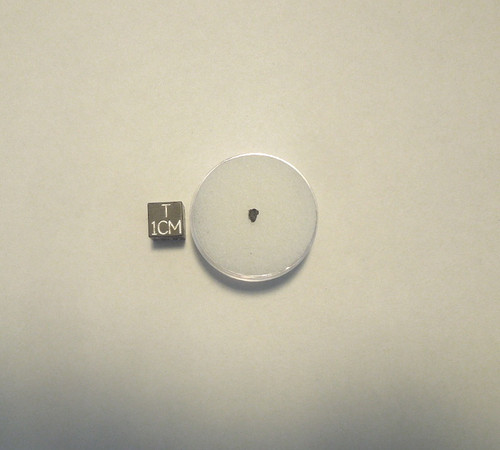
The specimens available here are small fragments that broke off during cutting. They are fresh interior fragments, although tiny flecks of crust may be present.
Refer to the photo. The black centimeter cube is shown for scale and is not included. You are purchasing a small fragment like the one shown. Your purchase will include a capsule and labeled gemjar for safe storage.
From the Meteoritical Bulletin entry on Amo :
Amo (39° 40' 18"N, 86° 38' 53"W)
Indiana, United States
Confirmed fall: 2024
Classification: Ordinary chondrite (L5)
History: A bright bolide was observed west of Indianapolis, Indiana, at 4:04 EST on December 10, 2024 (09:04:35 UTC as recorded in security videos). Data from six NEXRAD radars, along with the Indianapolis airport radar, revealed signatures of falling meteorites from which Marc Fries (JSC) prepared a strewnfield map that included the towns of Amo, Coatesville, and Fillmore. The first radar signature consistent with falling meteorites appears at 09:04:44 UTC, only eight seconds after the fireball terminus, at an altitude of 15.35 km above mean sea level (AMSL). A total of twenty-three radar sweeps from NEXRAD radars recorded falling meteorites, plus a detailed suite of recordings by the Terminal Weather Doppler Radar (TDWR) serving Indianapolis International Airport. The last signature appears in NEXRAD data at 09:13:46 UTC at 2900 m AMSL altitude, spanning a detection duration of nine minutes and two seconds. Calculated values of overall meteorite mass and number of falling meteorites indicate this fall was produced by a mechanically tough body producing one of the most massive meteorite falls observed since the NEXRAD system commenced operations in the late 1990s. The first stones were found on December 11, 2025, before precipitation, by Steve Arnold (57 g), Carl Dietrich (type specimen 45 g at latitude 39.672°N, longitude 86.647°W), on December 13, 2025 by Robert Ward (1016 g). After precipitation, additional stones were recovered, including a 9.1 kg by Ward and a 2 kg by Arnold.
Physical characteristics: Most stones are complete individuals with some fusion crust broken off upon impact.
Petrography: Metal and chondrule texture typical of L5 chondrites is apparent on cut surfaces. The metal volume estimate is 2.5% based on an Fe EDS map. Chondrules are visible in the polished section. The average chondrule diameter is 0.6±0.4 mm (N=29). Several chondrules are well-defined, and some have sharp boundaries. Feldspar grains vary in size and measure 3.4±2.2 µm (n=64) in a representative field of view. Phosphates constitute about 0.5% of the meteorite. Chromites appear to be fractured. No chromite, sulfide, or metal veinlets are observed within the meteorite. Some melt pockets are observed. The meteorite appears weakly shocked. Opaque melt veins occur only in close proximity to the fusion crust.
Geochemistry: Mineral Compositions and geochemistry: Olivine Fa26.4±0.4 (N=37). The average composition of low-Ca px is Fs22.6±0.5En76.3±0.5Wo1.2±0.4 (n=72) and of high-Ca px is Fs8.3±0.7En45.6±0.3Wo0.5±0.8 (n=9). Feldspar is present with an average composition of An11.0±1.7Ab83.4±1.9 Or5.6±0.7 (n=53). Chromite: TiO2=2.9±0.2 wt% V2O3=0.8±0.1 wt% (N=60). Apatite contains 4.4±0.7 wt% Cl and <1 wt% F.
Classification: The petrology, mineral chemistry and compositional heterogeneity of the minerals listed is consistent with L5 chondrites. The meteorite is classified as L5, S3, W0.