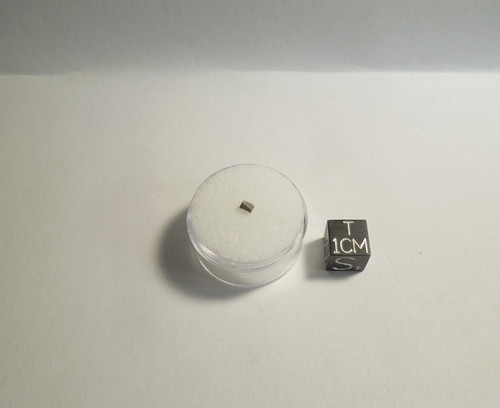
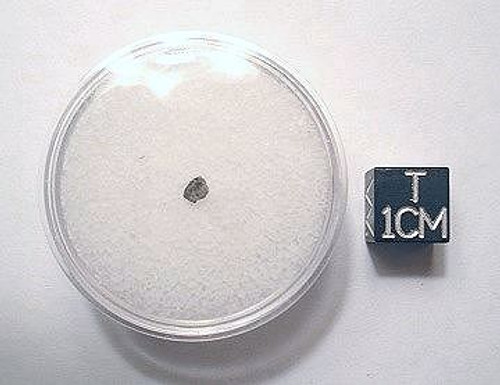
On March 17, 2026 a bright daytime fireball was observed over several states in the northeast US. It exploded over Ohio and sonic booms were heard as far away as Cleveland. Hundreds of small stones were eventually discovered in a strewnfield that stretches across a wide area of northeastern Ohio. Some stones have distinctive "spicules" on the glassy fusion crust.
Samples were sent for analysis and the official classification was determined to be a monomict eucrite that originates from the asteroid 4 Vesta. This is the first witnessed fall of a Vestan since the Qiquanhu fall in China in 2021 and it is the first witnessed fall of a Vestan in the USA since the 2004 Berthoud eucrite fall in Colorado.
I acquired these specimens from a reputable wholesale dealer who purchased a stone and cut it into smaller pieces. These small fragments were collected from the cutting process. Each specimen comes in a gelatin capsule to help protect it (the pieces are friable) and you get a labeled gemjar.
Refer to the photo. The black centimeter cube is shown for scale and is not included. You are purchasing a small specimen similar to the one shown. Each specimen is unique and the appearance may vary slightly.
From the Meteoritical Bulletin entry on Wadsworth :
Wadsworth 41°2.6973'N, 81°45.4308'W
Ohio, United States
Confirmed fall: 2026 Mar 17
Classification: HED achondrite (Eucrite, monomict)
History: (M. Fries, JSC; D. Sheikh, Cascadia): On the morning of March 17, 2026, a daytime bolide was observed across a wide area of the northeast United States. Sonic booms were reported over the Cleveland area. Signatures of falling meteorites are visible in data from three weather radars: the KPBZ (Pittsburgh) and KCLE (Cleveland) NEXRAD radars, and the TLVE airport radar. The earliest signature appears 11.77 km Above Mean Sea Level (AMSL) in KPBZ data at 12:57:45 UTC (8:57 am EDT), and the last occurs at 3.27 km AMSL in KCLE data at 13:10:2 UTC for an elapsed time of 12 mins 16 sec. A strewn field calculated using the Jörmungandr dark flight model predicted the fall of kg-mass stones south of Rittman, Ohio, with lighter stones predicted to the NE over a length of >30 km. The first stone (1.76 g) was found the next afternoon by Matt Perison in a parking lot in Sharon Center. Several hundred stones have since been found, defining a narrow strewnfield extending ~21.4 km SSW-NNE, overlapping the towns of Sharon Center (single stone finds <15 g in size), Wadsworth (~15-70 g), and Rittman (>70 g). The total mass recovered to date is 1728 g.
Physical characteristics: The meteorites are notable for their dark-black glossy fusion crust, which also varies from clear to brown. Some stones exhibit classic flight-orientation features with well-developed roll-over lips. Some have solidified glassy spicules adhering to the fusion crust. The stones are friable. Fusion crust is ~50-200 µm thick and vesicular.
Petrography: (D. Sheikh, Cascadia; L. Garvie and A. Wittmann, ASU; D. Dickens, LMAC; A. S. Bell, UColo; C. Agee, T. Shisseh, and M. Spilde, UNM; J. T. Michell, UMin; T. Irving, UWS; M. Kelly, PA): The sample represents a monomict breccia (variably brecciated across different sections) composed of up to ~1.2 mm-sized lithic/mineral clasts set within a finer-grained cataclastic matrix. Modal abundances based on a 2.5 × 6 mm area (ASU) are 45.2 areal% plagioclase, 45.1 areal% pyroxene, and 5.9 areal% silica, with the rest occupied by accessory phases, porosity, and cracks. The lithic clasts (silicate grain size generally ~0.2-0.6 mm, up to ~2 mm) display relict cumulate textures composed of subequal proportions of subhedral pyroxene and plagioclase, plus minor subhedral/anhedral tridymite (identified with EBSD). Low-Ca pyroxene host grains often contain <30 µm-sized augite exsolution lamellae (which are frequently decorated with up to 2 µm, acicular chromite crystals). Tridymite grains occasionally contain inclusions of troilite (~5 µm), chromite, and/or Fe-metal (Ni-free). Additional accessory phases observed include ilmenite and fluorapatite.
Geochemistry: (L. Garvie and A. Wittman, ASU; J. T. Mitchell, UMin; C. Agee, T. Shisseh, and M. Spilde, UNM; D. Dickens, LMAC; A. S. Bell, UColo): Low-Ca pyroxene (Fs58.8±0.9Wo1.5±0.2, range Fs55.3-60.8Wo1.1-2.8, Mg# = 40.3±0.8, Fe/Mn = 31±1, n=83); high-Ca pyroxene (Fs24.4±0.9Wo44.3±1.4, range Fs23.1-27.6Wo38.7-45.4, Mg# = 56.3±1.0, Fe/Mn = 28±2, n=42); calcic plagioclase (An90.8±0.5Or0.1±0.1, range An89.6-91.9Or0.0-0.3, n=57); chromite (Mg# = 1.9±0.4, Cr# = 80.2±1.1, n=19). Oxygen isotopes (K. Ziegler, UNM): 8 untreated subsamples (weighing between 1.8-2.7 mg) analyzed by laser fluorination gave δ18O = 4.161, 3.717, 5.130, 4.224, 4.319, 4.999, 5.136, 5.224; δ17O = 1.880, 1.717, 2.349, 1.922, 1.990, 2.314, 2.348, 2.371; Δ17O = -0.317, -0.246, -0.359, -0.308, -0.290, -0.325, -0.363, -0.387 (all data linearized, in per mil, TFL slope=0.528).
Classification: (Ohio Meteorite Classification [OMC] Team - D. Sheikh, Cascadia; L. Garvie and A. Wittmann, ASU; J. T. Mitchell, UMin; D. Dickens, LMAC; A. S. Bell, UColo; C. Agee, K. Ziegler, T. Shisseh, and M. Spilde, UNM; M. Fries, JSC; T. Irving, UWS; A. Love, App; P. Carpenter, WUSL; L. Welzenbach Fries, Rice; C. Goodrich and B. Balta, XSPACE) HED achondrite (eucrite, monomict). Pyroxene Fe/Mn ratios and oxygen isotopes overlap with HED achondrites. Pyroxene, plagioclase, and chromite chemistry overlap with basaltic eucrites (Mittlefehldt, 2015).