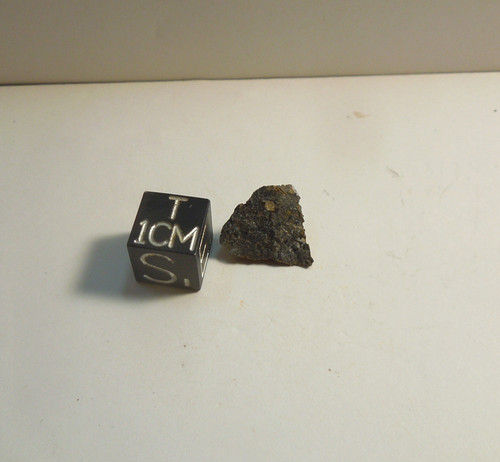
NWA 8036 was recovered out of the Moroccan Sahara in 2013. It was analyzed and classified as a polymict eucrite breccia. The texture is very much like a shocked melt, even though the shock rating is listed as "moderate". It has a darkened matrix with contrasting lighter-colored clasts. Some of the clasts are small and rounded to resemble chondrules, although they are not chondrules.
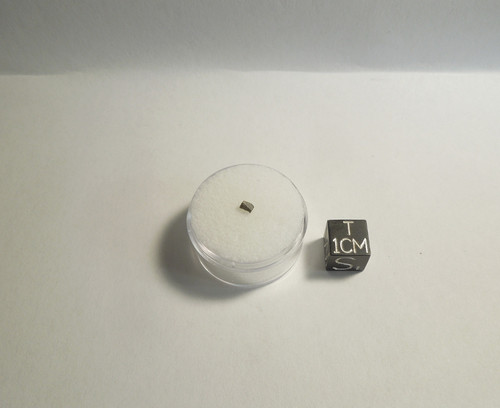
Refer to the photo. The black centimeter cube is shown for scale and is not included. You are purchasing a small fragment like the one shown. Your purchase will include a labeled gemjar.
From the Meteoritical Bulletin entry on NWA 8036 :
Purchased: 2013 Aug
Classification: HED achondrite (Eucrite, polymict)
History: Purchased by GHupé in August 2013 from a dealer in Erfoud, Morocco.
Physical characteristics: A group of 21 similar stones (total weight 1612 g) exhibiting weathered exterior surfaces and interiors characterized by separated white clasts with some brown staining in a dark matrix. GHupé has cut every stone and carefully examined their interiors as well as exteriors; together with A. Irving it was concluded they were the same material (and the same as the type specimen)
Petrography: (A. Irving and S. Kuehner, UWS) Fragmental breccia composed of small gabbroic eucrite clasts and matrix of related debris, with rare clasts of diogenitic orthopyroxene. Primary minerals are exsolved pigeonite (with variable red-brown staining), calcic plagioclase (polycrystalline, birefringent), silica polymorph, ilmenite, Ti-bearing chromite and troilite; secondary barite and calcite are present.
Geochemistry: Orthopyroxene host (Fs58.2Wo3.9, FeO/MnO =30), clinopyroxene exsolution lamella (Fs28.4Wo41.4, FeO/MnO = 30), diogenitic orthopyroxene (Fs17.0Wo1.1, FeO/MnO =29; Fs35.4Wo1.2, FeO/MnO = 38).
Classification: Eucrite (polymict, gabbroic). Based on primary textures, shock features and style of weathering, these stones are likely paired with NWA 7989.